
If you are in the Express Entry pool right now, the last few weeks may have felt unsettling. On November 3, 2026, Immigration, Refugees and Citizenship Canada (IRCC) changed how the Comprehensive Ranking System (CRS) scores Canadian work experience and job offers, and paused rounds of invitations while it recalculates every profile. This piece from our desk has two parts. First, a plain walk through how the CRS works today, section by section. Second, a look at what sets a round’s cut-off score and a few scenarios for where cut-offs could go once rounds restart, built from IRCC’s own 2026 numbers. The scenarios are our reading of the data, not predictions.
The four sections of the CRS
Every profile is scored on the same four sections. Having a spouse or common-law partner coming with you changes how the core points are split, but not the overall maximum.
| Section | With a spouse or partner | Without a spouse or partner |
|---|---|---|
| Core human capital factors | 530 | 570 |
| Spouse or partner factors | 40 | 0 |
| Skill transferability | 100 | 100 |
| Additional points | 600 | 600 |
| Total | 1,270 | 1,270 |
Core factors and the new Labour Market Integration factor
| Factor | With a spouse or partner | Without a spouse or partner |
|---|---|---|
| Age | 100 | 110 |
| Level of education | 140 | 150 |
| First official language | 128 | 136 |
| Second official language | 22 | 24 |
| Labour Market Integration | 140 | 150 |
Labour Market Integration is the new part. It counts either your Canadian work experience (the work-length points, plus 20, 40 or 70 more if at least 12 months were in a high-wage occupation) or a qualifying job offer in a high-wage occupation (50, 70 or 100), whichever is worth more, never both. Our guide to the November 2026 CRS changes walks through every table, so we won’t repeat them here.
How high-wage occupations are decided
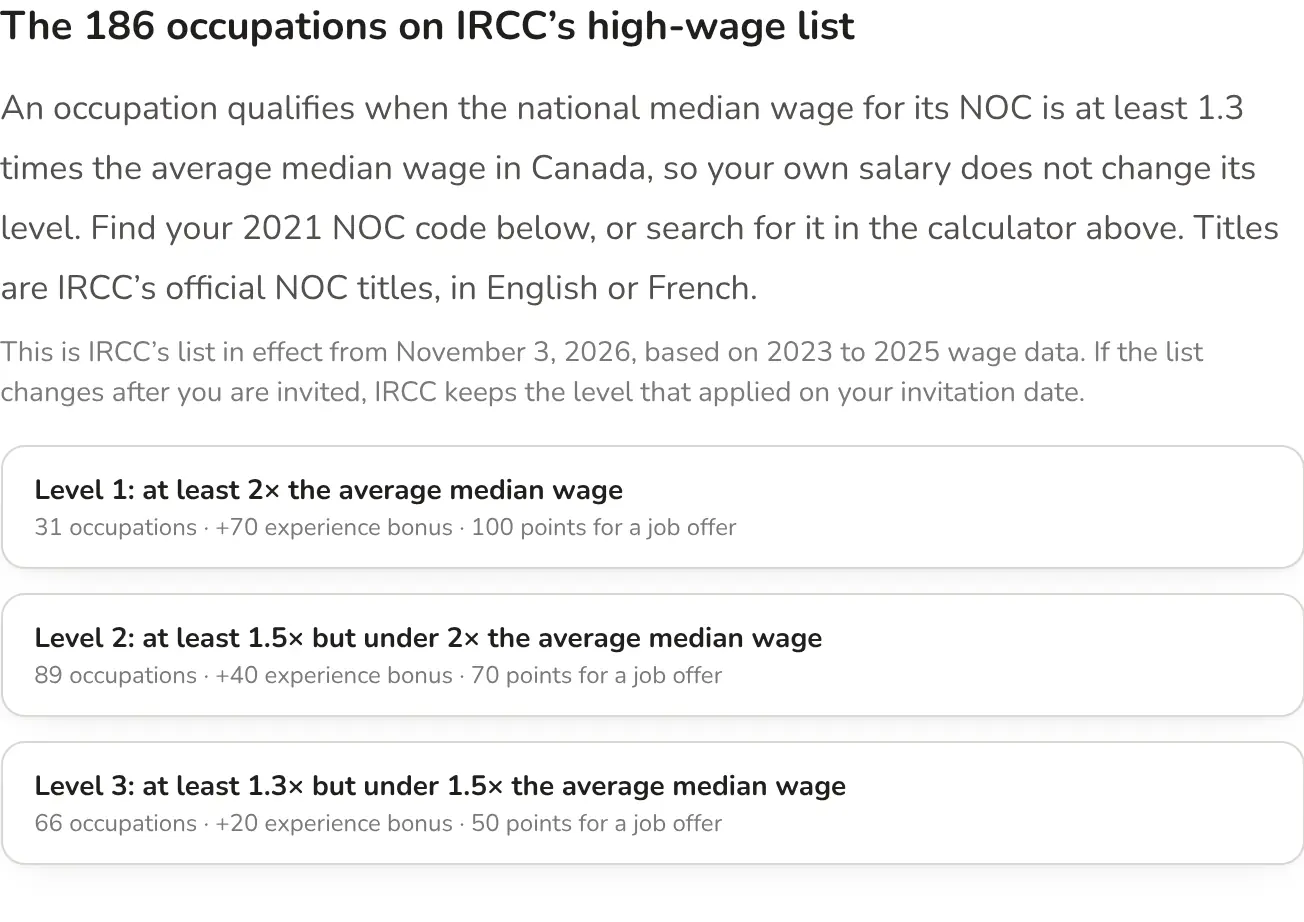
A job is high-wage because of its National Occupational Classification (NOC) code, not because of your own pay. IRCC compares the median wage of everyone in Canada working in that NOC with the average median wage of the whole workforce. Level 1 is at least 2 times that average, Level 2 at least 1.5 times and Level 3 at least 1.3 times. The list in effect from November 3, 2026 has 186 occupations (31 at Level 1, 89 at Level 2 and 66 at Level 3), based on wage data from 2023 to 2025. If the list changes after you are invited, IRCC keeps the level that applied on the day of your invitation. You can check your NOC in our CRS calculator.
Skill transferability
These points reward combinations of strengths, up to 100 in total. Each group is capped at 50:
- Education combined with strong language results or with Canadian work experience (up to 50 together).
- Foreign work experience combined with strong language results or with Canadian work experience (up to 50 together).
- A certificate of qualification in a trade combined with strong language results (up to 50).
- The Canadian work experience used here is still measured by length (1 year, or 2 years or more), not by the high-wage rules.
Additional points
| What you have | Points |
|---|---|
| A provincial or territorial nomination | 600 |
| NCLC 7 or higher in all four French abilities, and CLB 5 or higher in all four English abilities | 50 |
| NCLC 7 or higher in all four French abilities, and CLB 4 or lower in English (or no English test) | 25 |
| A brother or sister aged 18 or older who lives in Canada and is a citizen or permanent resident | 15 |
| A Canadian post-secondary credential from a program of 3 years or longer | 30 |
| A Canadian post-secondary credential from a program of 1 or 2 years | 15 |
Two worked examples
- 01
Example A: Canadian experience, no spouse
Age 29 (110), a bachelor’s degree (120), CLB 9 in all four English abilities (124) and 2 years of Canadian work in an occupation that is not on the high-wage list (53) give 407 core points. Skill transferability adds 50 (25 for education with CLB 9, plus 25 for education with 2 years of Canadian work). Total: 457. If 12 of those months had been in a Level 1 occupation, Labour Market Integration would add 70, for 527.
- 02
Example B: French and foreign experience, no spouse
Age 30 (105), a bachelor’s degree (120), CLB 10 in all four English abilities (136), NCLC 7 in all four French abilities as a second language (12) and no Canadian work give 373 core points. Skill transferability adds 75 (25 for education with CLB 9 or higher, plus 50 for 3 or more years of foreign work with CLB 9 or higher). French adds 50 additional points. Total: 498.
- 03
What a nomination does
A provincial or territorial nomination adds 600. Example A with a nomination would be 1,057 (or 1,127 with the high-wage points). That is why Provincial Nominee Program rounds have cut-offs far above every other round type.
What sets a round’s cut-off
In each round, IRCC decides how many candidates it needs to invite and which group is eligible (everyone, one program, provincial nominees or a category). It then invites the highest-ranked eligible candidates. The cut-off is simply the score of the last person invited. If several people share that score, IRCC uses the date and time they submitted their profile to break the tie. So a cut-off is not a pass mark set in advance: it is the result of four things working together.
- Round size: the more invitations, the further down the ranking IRCC reaches, and the lower the cut-off tends to be.
- Round type: a round only for nominees, French speakers or one category ranks a smaller group, so its cut-off reflects that group, not the whole pool.
- The pool’s score distribution: how many eligible candidates sit just above and just below the last cut-off.
- How often rounds run: frequent rounds invite people before many high scores build up; long gaps let more high scorers gather, which can lift the next cut-off.
2026 cut-offs by round type
| Round type | Rounds | Invitations per round | Cut-off range |
|---|---|---|---|
| Canadian Experience Class | 18 | Usually 2,000 to 3,000 (from 1,000 to 8,000) | 507 to 523 |
| Provincial Nominee Program | 21 | 264 to 955 | 697 to 805 |
| French-language proficiency | 12 | Usually 5,000 (from 4,000 to 8,500) | 382 to 435 |
| Healthcare and social services | 3 | 3,500 to 4,000 | 467 to 475 |
| Trades | 2 | 3,000 to 3,500 | 476 to 477 |
| Transport | 2 | 150 to 300 | 470 to 477 |
| Physicians with Canadian work experience | 3 | 229 to 391 | 169 to 223 |
| Senior managers with Canadian work experience | 3 | 250 to 500 | 389 to 429 |
| Skilled military recruits | 1 | 4 | 368 |
| General rounds (all programs) | 0 | None | None |
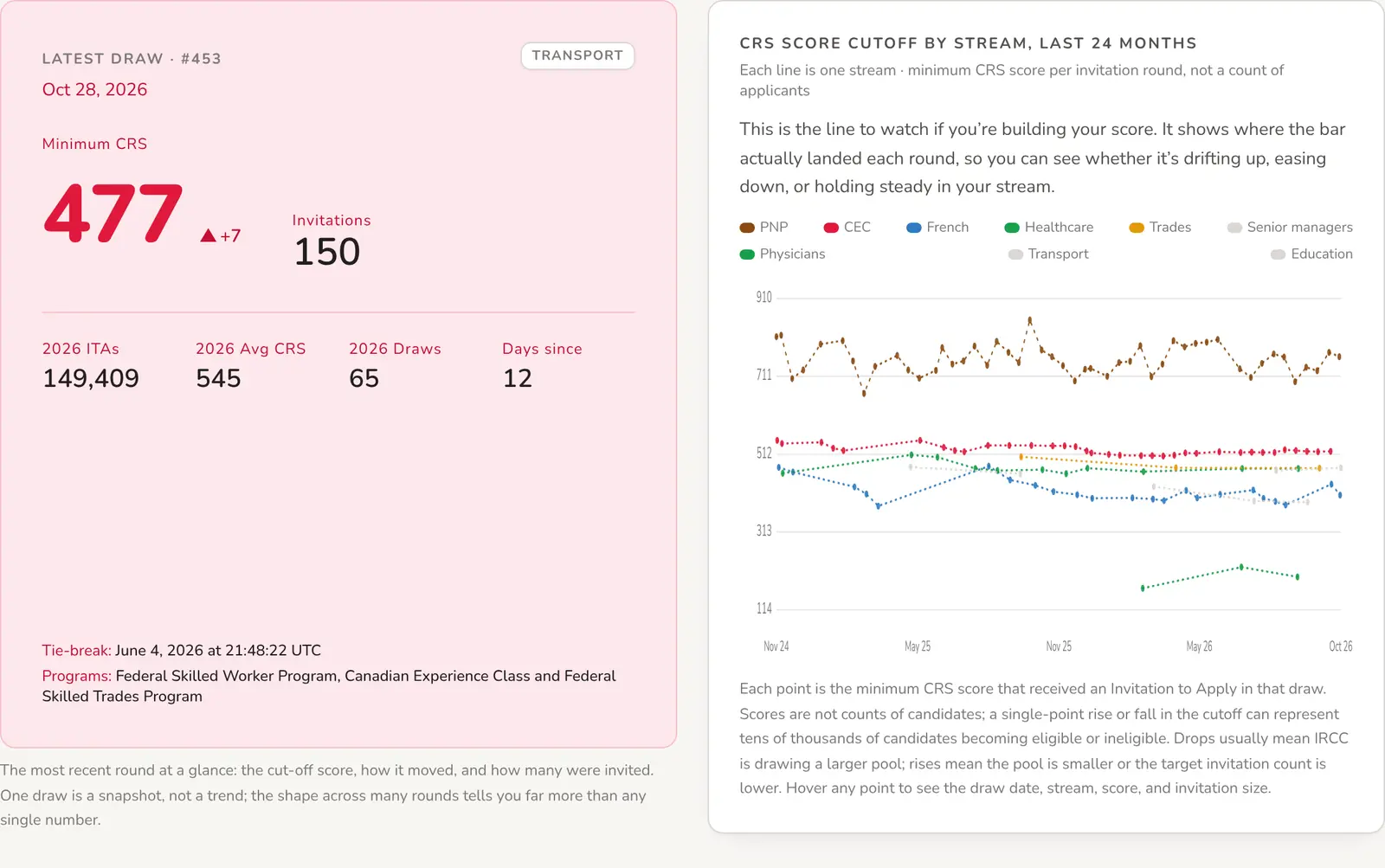
A few patterns stand out. Round size matters: the largest Canadian Experience Class round, 8,000 invitations on January 7, closed at 511, while the smallest, 1,000 invitations on August 18, closed at 523. Provincial Nominee Program cut-offs sit above 600 because every nominee has the extra 600 points. There were no general rounds open to all programs in 2026. And IRCC usually held rounds in a group about every two weeks: a Provincial Nominee Program round, then a Canadian Experience Class round, then a French or category round within a few days.
The pool just before the change
| CRS score | Candidates |
|---|---|
| 601 to 1,200 | 787 |
| 501 to 600 | 20,535 |
| 451 to 500 | 71,112 |
| 401 to 450 | 63,505 |
| 351 to 400 | 47,911 |
| 301 to 350 | 17,247 |
| 0 to 300 | 7,627 |
| Total | 228,724 |
These are scores under the old rules. About 21,300 candidates were above 500, and more than 71,000 were between 451 and 500. For Canadian Experience Class rounds, the band just above 500 is where cut-offs were decided all year, although not everyone in a band is eligible for every round. The recalculation adds points for candidates with high-wage Canadian experience or a high-wage job offer, so some people in the lower bands will move up. IRCC has not published how many profiles gained points.
Have rounds resumed?
Not yet, as far as IRCC’s pages show on November 7, 2026. IRCC’s “Check your score” page, updated November 5, says the system is recalculating points in existing profiles, which could take up to two weeks, and that rounds are paused until that is complete. The most recent round in IRCC’s rounds data is round 453 on October 28, 2026, a Transport round. Our draws page shows each new round as soon as it is published, so you will see the first one there.
Scenarios for the next rounds
Our view from the desk: the new factor adds points to some profiles and the work-length points are unchanged, so the arithmetic pushes Canadian Experience Class cut-offs upward. But round size can pull the other way, and IRCC controls that. Here is how we reason about it.
| Force | Could push cut-offs up | Could push cut-offs down |
|---|---|---|
| New points | Many candidates near the old cut-off gain 20 to 100 points and move ahead | Few candidates gain points, or the gains go mostly to people already far above the cut-off |
| Round size | Rounds stay at around 2,000 invitations, as in most of 2026 | IRCC holds larger rounds, like the 6,000 and 8,000 rounds of early 2026 |
| Pause and frequency | The pause lets new high-scoring profiles build up before the first round | Rounds come often once they restart and clear the backlog |
| Mix of round types | More rounds for narrow groups leave fewer invitations for everyone else | More large program or general rounds reach further down the pool |
To see why, take a candidate at 510 before the change, with 12 months in a Level 2 occupation. They now have 550 and pass everyone between 511 and 549 who gained no points. If several thousand candidates move up like this, a round of 2,000 fills before it reaches scores that were enough in October.
| Round type | 2026 range | Steady scenario | Higher scenario | Lower scenario |
|---|---|---|---|---|
| Canadian Experience Class | 507 to 523 | About 505 to 525, if few candidates near the cut-off gained points | Roughly 525 to 590: the 2026 high plus part of a 20 to 70 point gain | Below 505, mainly if rounds grow well beyond 2,000 invitations |
| Provincial Nominee Program | 697 to 805 | About 700 to 800 | Above 805, because nominees with high-wage experience or offers gain points too | Below 700, if rounds invite many more nominees at once |
| French-language proficiency | 382 to 435 | About 380 to 435 | Above 435, if many French speakers also have high-wage Canadian experience | Below 380, if rounds grow beyond the 5,000 to 8,500 of 2026 |
| Healthcare, trades and transport | 467 to 477 | About 465 to 480 | Higher, if many candidates in these occupations gain high-wage points | Lower, if IRCC holds larger or more frequent category rounds |
| Physicians and senior managers | 169 to 429 | Wide swings, as in 2026, because these groups are small | Higher, if these candidates gain high-wage points | Lower, if rounds invite most of a small group |
When rounds restart, compare the first cut-offs with these scenarios on our draws page. The first rounds after a big change can be unusual, so we suggest watching several rounds before drawing conclusions.
What you can do now
- 01
Check your score after the recalculation
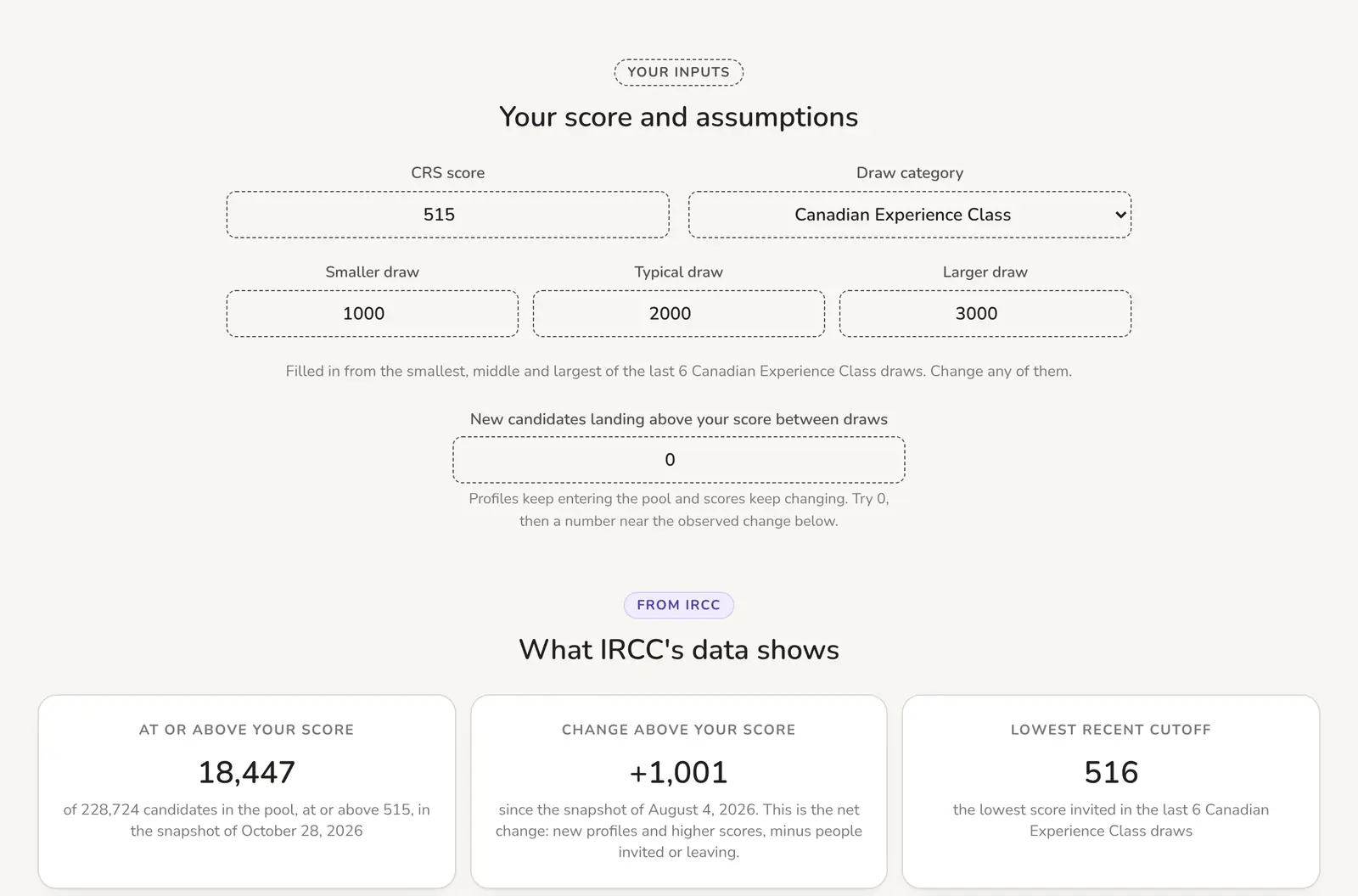
Sign in to your IRCC account once the recalculation is finished and note your new score. That number, not a forecast, is what matters for you.
- 02
Re-estimate with the calculator
Use our CRS calculator to see which Labour Market Integration route counts for you and which other factors could add points.
- 03
Focus on what you control
Retaking a language test, adding French, getting credit for a second credential or exploring a provincial nomination can all add points. Small gains can matter when cut-offs are decided by a few points.
- 04
Keep your profile accurate
Update your profile if your job, job offer or language results change. Never claim points you cannot prove: an officer checks everything when you apply.
- 05
Watch real rounds, not rumours
Follow each round on our draws page and on canada.ca as it is published, and be wary of anyone who claims to know the next cut-off.
Frequently asked questions
Will cut-offs go up after the change?
Nobody knows. More points for some candidates puts upward pressure on some rounds, but IRCC sets round sizes and types, and larger rounds would pull cut-offs down. That is why we show scenarios, not a forecast.
Why are PNP cut-offs so high?
Every candidate in a Provincial Nominee Program round has a nomination, worth 600 points. Take away the 600 and the 2026 cut-offs of 697 to 805 correspond to about 97 to 205 points from the other sections.
My score did not change. Am I worse off?
Your points did not go down, but if others gained points, your rank may have moved. Rank is what decides an invitation. Look at the rounds you are eligible for, and at what you can still improve.
Can I compare my new score with cut-offs from before November 3?
Only with care. Those cut-offs were set under the old rules, when nobody had high-wage points. The first rounds after the pause will be a better basis for comparison.
When will rounds restart?
IRCC says rounds will start again when the recalculation is complete, which it said could take up to two weeks. It has not published a date. Our draws page shows the first round as soon as IRCC publishes it.
You don’t have to face the wait alone.
Thousands of people have shared their real timelines so the next person isn’t left guessing in the dark. Add yours, keep your own application and your family’s together in one place, and see a grounded estimate of how long your decision might take, drawn from people who are walking the same path.
- Share your timeline and help the next applicant find their footing.
- Track your own and your family’s applications together, in one calm place.
- See a realistic estimate of your wait, based on people on the same journey.
It’s free, and what you track stays private to you. Sharing your timeline with the community is always your choice.
Key takeaways
- Your CRS score is the sum of four sections worth up to 1,270 points, with the new Labour Market Integration factor inside the core section.
- A round’s cut-off is the score of the last person invited, so it moves with round size, round type and who is in the pool.
- Rounds are paused while IRCC recalculates profiles, and our scenarios for the next cut-offs are scenarios, not predictions.
- IRCC: Comprehensive Ranking System criteria (opens in a new tab)
- IRCC: 2026 changes to points for Canadian work experience and job offers (opens in a new tab)
- IRCC: High-wage occupations list (opens in a new tab)
- IRCC: Express Entry, check your score (recalculation and pause of rounds) (opens in a new tab)
- IRCC: Express Entry rounds of invitations (opens in a new tab)
- IRCC: Express Entry rounds of invitations data (JSON feed) (opens in a new tab)
- IRCC: Changes to Express Entry for high-wage occupations (October 2026) (opens in a new tab)
Last reviewed: Nov 7, 2026