
If you hold a work permit in Canada, you have probably seen headlines about "temporary foreign workers" and wondered whether they are talking about you. Often the answer is: not really. Canada has two very different work permit programs, and public conversation tends to fold them into one. That can leave graduates, spouses, young travellers and skilled transferees feeling blamed for rules that were never written about them, or worried about changes that do not touch their permit. This guide untangles the two, using IRCC’s own numbers, so you can read the news calmly and know where you stand.
Two programs, often called by one name
The Temporary Foreign Worker Program (TFWP) is run with Employment and Social Development Canada (ESDC). Before hiring, the employer applies to ESDC for a Labour Market Impact Assessment (LMIA), which checks that hiring from abroad will not take a job a Canadian or permanent resident could fill. Only then can the worker apply to IRCC for a permit tied to that employer. The International Mobility Program (IMP) is run by IRCC alone and covers every work permit that is exempt from an LMIA. Some IMP permits are open, so you can work for almost any employer; others are tied to one employer, who submits an offer of employment through IRCC’s Employer Portal instead of getting an LMIA. Both programs give people a real work permit; they simply exist for different reasons.
| Temporary Foreign Worker Program | International Mobility Program | |
|---|---|---|
| Who runs it | ESDC (the LMIA) and IRCC (the permit) | IRCC |
| Does the employer need an LMIA? | Yes, for every position | No |
| Employer’s fee | $1,000 LMIA processing fee per position | $230 employer compliance fee for employer-specific permits, unless exempt; none for open permits |
| Kind of permit | Always tied to one employer | Open or tied to one employer, depending on the category |
| Permits that took effect in 2025 | 169,330 (about 22%) | 585,585 (about 78%) |
| Planned new arrivals each year, 2027 to 2029 | 50,000 | 170,000 |
Who is in the International Mobility Program
The IMP is not one stream but a family of them. Each exists because Canada has decided the work brings a broader benefit: to the economy, to Canada’s trade partners, to families, or to young people on both sides of an exchange. The ones you are most likely to meet are:
- Graduates of Canadian colleges and universities on a Post-Graduation Work Permit (PGWP), an open permit.
- Spouses and partners, and in some cases children, of eligible students, skilled workers and people applying for permanent residence, on family open work permits.
- Young people from partner countries in International Experience Canada (IEC), including the Working Holiday open permit, Young Professionals and International Co-op.
- Intra-company transferees: executives, managers and specialists moving within the same company.
- Professionals, traders and investors under trade agreements such as CUSMA, CETA and CPTPP.
- People already applying for permanent residence, who keep working on a Bridging Open Work Permit (BOWP) while IRCC decides.
- Smaller streams with a clear public purpose, such as francophone mobility, researchers, co-op students, charitable and religious work, and open permits for workers leaving an abusive job.
Being exempt from an LMIA does not always mean being free to change jobs: a CUSMA professional, for example, needs no LMIA but is still tied to one employer. Our work permit guide explains open and employer-specific permits in more detail.
What IRCC’s numbers say
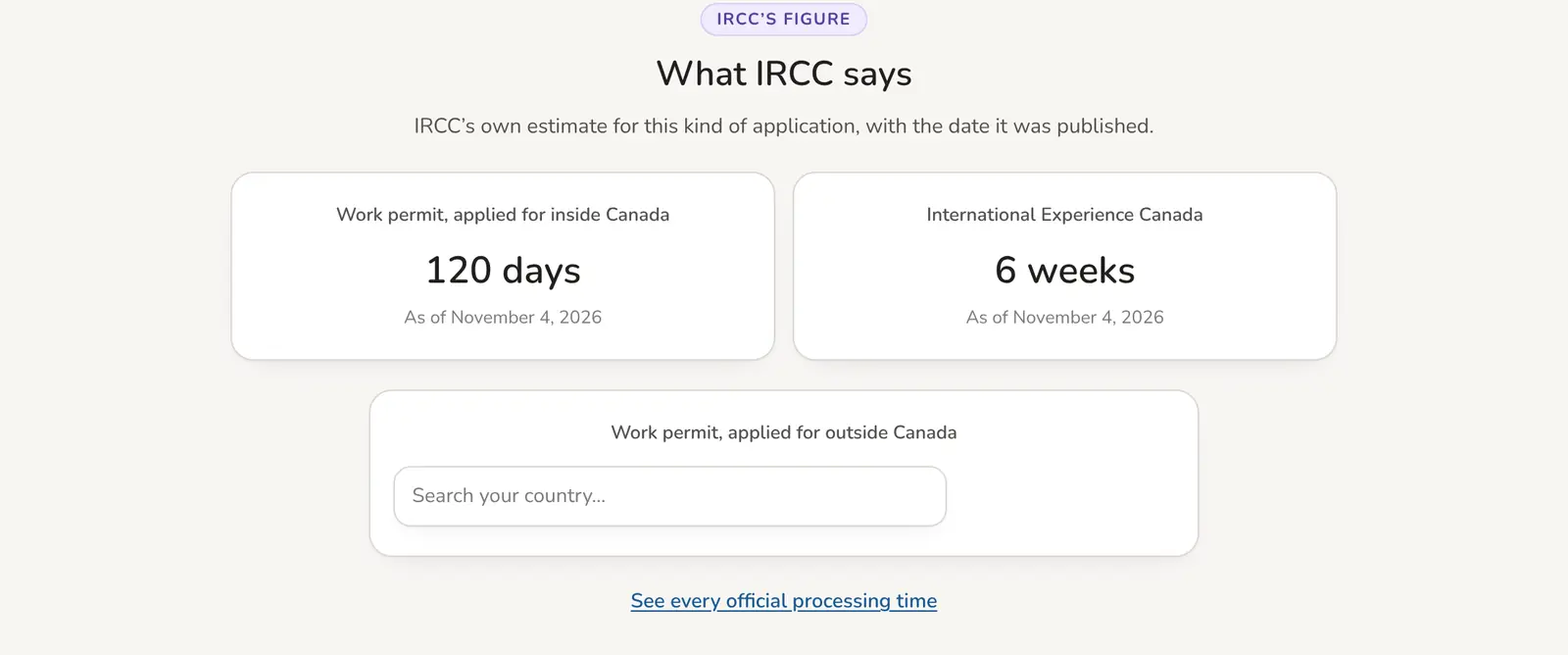
IRCC publishes how many work permits take effect each year, split by program. In 2025, 754,915 work permits took effect. Of those, 585,585 were under the International Mobility Program and 169,330 under the Temporary Foreign Worker Program. Inside each program, IRCC groups them like this:
- IMP, "Canadian interests": 436,285. This is the largest group, and it covers most of the categories listed above.
- IMP, "other participants": 112,375, and international agreements such as CUSMA: 26,795.
- TFWP: 67,670 agricultural workers and 98,255 other workers with an LMIA, the group most people picture when they hear "temporary foreign worker".
Why the mix-up matters for you
When "temporary foreign workers" is used for everyone, it blurs who a policy actually affects. A few habits help:
- When you read about a change to LMIAs, wages for LMIA jobs, or limits on low-wage LMIA positions, that is a TFWP rule. On its own, it does not change a PGWP, a spousal open work permit or an IEC permit.
- When you read about PGWP eligibility, family open work permits or IEC quotas, that is an IMP rule, and it will not change an LMIA-based permit.
- When a headline gives one big number for "temporary foreign workers", ask which program it counts. In 2025, nearly four in five work permits were not in the TFWP.
- Your own permit tells you which program you are in: if it is open, or if your employer never needed an LMIA, you are in the IMP.
Protecting yourself from people who use the confusion
Mix-ups like this create room for people who sell "LMIA jobs" or promise a permit for a fee. Whichever program you are in, a few things stay true:
- An LMIA is applied for and paid for by the employer. If anyone asks you to buy one, or to pay for a job offer, treat it as a warning sign.
- Under the TFWP, ESDC says your employer cannot make you pay to get or keep your job, cannot ask you to repay recruitment fees, and cannot take your passport or work permit. IRCC publishes a separate guide to your rights for IMP workers.
- A worker on an employer-specific permit who is being abused can apply for an open work permit for vulnerable workers, which is itself part of the IMP.
If something feels wrong, you can check an offer or a representative against IRCC’s fraud and scams pages before you pay anything or share your documents.
Both programs can lead to permanent residence
Skilled work in TEER 0, 1, 2 or 3 counts toward the Canadian Experience Class whether your permit came through the TFWP or the IMP, and many provincial streams accept both too. So a PGWP holder and an LMIA-based worker can be building toward the same goal. If you have already applied, a Bridging Open Work Permit can keep you working while you wait. Our Express Entry guide walks through the next steps.
Frequently asked questions
I am on a PGWP. Am I a "temporary foreign worker"?
In everyday speech, people may say so, because you are a foreign national working on a temporary permit. But you are not in the Temporary Foreign Worker Program. A PGWP is an open permit under the International Mobility Program, and your employer never needed an LMIA to hire you.
If the government limits LMIAs, can my spousal open work permit be affected?
Not by that change on its own. LMIA rules apply to TFWP positions. Family open work permits have their own eligibility rules under the IMP, which IRCC changed separately in January 2025, so check the rules for your own permit type.
Does an IMP permit cost my employer anything?
For an employer-specific IMP permit, the employer usually submits an offer of employment through the Employer Portal and pays a $230 employer compliance fee, unless the category is exempt. For an open permit, the employer pays nothing; you pay the $100 open work permit holder fee on top of the $155 processing fee.
Is the International Mobility Program easier or harder to get into?
Neither, really. It is not a single program you apply to. You qualify for one of its categories, such as a PGWP after eligible studies or an IEC permit if your country has an agreement with Canada, and each category has its own rules.
Where do these numbers come from?
From IRCC’s open data on work permit holders by program and year, the same figures our Trends pages use. They count permits by the year they took effect and are rounded by IRCC to the nearest five. The planned arrivals come from the 2027 to 2029 Immigration Levels Plan.
You don’t have to face the wait alone.
Thousands of people have shared their real timelines so the next person isn’t left guessing in the dark. Add yours, keep your own application and your family’s together in one place, and see a grounded estimate of how long your decision might take, drawn from people who are walking the same path.
- Share your timeline and help the next applicant find their footing.
- Track your own and your family’s applications together, in one calm place.
- See a realistic estimate of your wait, based on people on the same journey.
It’s free, and what you track stays private to you. Sharing your timeline with the community is always your choice.
Key takeaways
- The Temporary Foreign Worker Program needs an LMIA; the International Mobility Program covers every work permit that does not.
- In 2025, 585,585 of the 754,915 work permits that took effect (about 78%) were in the International Mobility Program.
- PGWPs, family open work permits, IEC, intra-company transfers and BOWPs are all IMP, so LMIA rule changes do not, on their own, touch them.
- IRCC: Hire a temporary worker through the International Mobility Program (opens in a new tab)
- IRCC: LMIA exemption codes (program delivery instructions) (opens in a new tab)
- ESDC: Hire a temporary foreign worker (Temporary Foreign Worker Program) (opens in a new tab)
- ESDC: Temporary foreign workers, your rights are protected (opens in a new tab)
- IRCC open data: Temporary residents, work permit holders by program (opens in a new tab)
- IRCC: Protect yourself from fraud and scams (opens in a new tab)
Last reviewed: Nov 7, 2026